Showing posts with label Nature. Show all posts

How to reduce emissions of greenhouse gas emissions by 80% by 2050?

Disruption of the water cycle, rising sea levels, species extinction, extreme weather events as well as epidemics or economic downturns could be ultimately the consequences of global warming. To contribute to international debate on a low-carbon economy in 2050, Nathalie Kosciusko-Morizet launched 27 June 2011 a task force to identify the best scenarios for reducing greenhouse gas emissions in France.

Towards a low-carbon economy 
"Paths 2020-2050 - Towards a low-carbon economy", is a committee chaired by Christian de Perthuis, professor of economics at the University of Paris-Dauphine and expert economic climate, and supported by the Centre for Strategic Analysis (CAS). It brings together some forty participants.
It will analyze in October 2011 by the possible scenarios, taking into account all economic, social, health and environmental. His work will help guide strategies for emission reductions and long-term investment at the national level, and to clarify the French position on raising the ambition in 2020.
 The economic crisis should not blind us to the urgent issue of climate. Maturities 2020 and 2050 may seem distant, but are preparing today. To develop a roadmap will enable stakeholders to anticipate the transition of our economy and make it an opportunity for growth and employment  , "said Nathalie Kosciusko-Morizet.
The objectives of the international community ....
The international community has set a goal to Cancun to limit the rise in average temperature below 2 ° C compared to preindustrial times. According to the evaluations of the Intergovernmental Panel on Climate Change (IPCC) this goal requires a halving of global greenhouse gas emissions by 2050 and a reduction of at least 80% by 2050 for OECD countries.
In a situation of economic crisis and on the eve of the Durban Conference, the roadmap to achieve this goal in 2050 is the subject of intense debate. While the European Union adopted in 2008 under the French Presidency measures enabling it to reduce its emissions by 20% in 2020, the European Commission now estimates that the scenario most effective in achieving the goal would be a 25 % in 2020, 40% in 2030 and 60% in 2040.
Give rise to heated debates
Because of the Polish opposition to any new commitments, the discussion could not advance to the European Council of June 21 France, meanwhile, has not yet officially positioned on the question of raising the commitment in 2020. In fact the acceleration of the transition to a low-carbon economy must be considered in the alder a national debate on the best path depth to reach the target in 2050. On what basis to share the effort between different sectors of the economy? What would be the impact on business competitiveness and the job market? How to evaluate the investment required to raise our ambitions and the means of financing? What are the instruments to implement climate ambition to reconcile the economic efficiency and social?

History of Chocolate (lifecycle)

Chocolate comes of age as a health treat.

Chocolate. There are few foods that evoke as much passion as this decadent treat. Folklore from many cultures claimed that consuming chocolate instilled faith, health, strength, and sexual passion. Once an indulgence of royalty, it is now a treasured and accessible - and yes, even healthy - treat. So where did our infatuation with chocolate begin?

Where does chocolate come from, anyway?

The cacao tree, whose pods contain seeds that can be processed into chocolate, was discovered 2,000 years ago in the tropical rainforests of the Americas. The first people known to have consumed cacao were the Classic Period Maya (250-900 A.D.). They mixed ground cacao (cocoa) seeds with seasonings to make a bitter, spicy drink that was believed to be a health elixir.

What was chocolate's great allure?

To the Mayans, cocoa pods symbolized life and fertility. The pod was often represented in religious rituals, including marriage ceremonies, and was referred to as food of the gods. In central Mexico, the Aztecs believed that wisdom and power came from eating the fruit of the cocoa tree, and that it had nourishing, fortifying, and even aphrodisiac qualities. The Aztec emperor Montezuma even drank liquid chocolate daily to enhance his libido.

Europeans get a taste of chocolate - and fall in love.
Europeans got their first taste of chocolate in 1519, when Montezuma offered the spicy drink to Spanish explorer Cortes and his army. The Spanish conquistadors brought cocoa seeds back to Spain, where they introduced new spices and sugar to the liquid concoction. The fad drink spread throughout Europe, where it remained a beverage of the elite for centuries.

Chocolate becomes known for its powers of seduction.

Chocolate's reputation as an aphrodisiac flourished in the French royal court. Erotic art and literature were inspired by the seductive substance. Casanova, the infamous womanizer, made a habit of drinking chocolate before his romantic escapades. Even today, romantic lore commonly identifies chocolate as an aphrodisiac.

Chocolate goes global.

The first machine-made chocolate was produced in Barcelona in 1780, paving the way for the mass production of chocolate. Later, mechanical inventions made it possible to produce smooth, creamy, solid chocolate for eating - not just the liquid for drinking. The first solid chocolate bar was developed by British chocolate maker Fry & Sons in the early 1800s.

When did chocolate become associated with Valentine's Day?

"It's believed that during the 17th century, lovers began exchanging mementos on Valentine's Day - sweet treats were one of them. In 1868, the first Valentine's Day box of chocolates was introduced [by Richard Cadbury]," - says Susan L. Fussell, senior director of communications for the National Confectioners Association.

Three cheers for chocolate!

In 1875, the first milk chocolate was introduced to the market by Daniel Peter of Switzerland. Chocolate became so popular around the world that even during World War II the U.S. government shipped cocoa beans to the troops. Today, the U.S. Army includes chocolate bars in their rations. Chocolate has even been taken into space as part of the diet of U.S. astronauts.

Is chocolate really an aphrodisiac?

Not really, even though throughout its history, chocolate has been purported as one. Chocolate contains small amounts of a chemical called phenylethylamine (PEA), a.k.a. the "love drug," and it's been linked to the regulation of physical energy, mood, and attention. A tiny amount of PEA is released at moments of emotional euphoria, elevating blood pressure and heart rate. There is no evidence that PEA found in foods increases PEA in the brain - although many chocolate lovers may beg to differ!

The 21st Century: Chocolate makes health headlines.

Dark chocolate (as opposed to milk or white chocolate) contains healthful flavonoids similar to those found in tea, red wine, fruits, and vegetables. Studies have shown that small portions of dark chocolate can improve blood vessel flow and may improve blood sugar and insulin sensitivity to help reduce the risk of diabetes. But beware, chocolate candy has plenty of saturated fat and sugar, which can lead to weight gain, so enjoy small portions of as part of a healthy diet.

Top Monsoon Flower Plants For Your Garden

If you have a big garden, you can have more monsoon plants. Gardening in the rainy season can be more fun with these monsoon plants. These flowering plants also add a colorful tint to the lush green foliage to your garden. Have a look at a few more top monsoon plants that are listed below.
 
Eight More Top Monsoon Plant
 
1. YELLOW BLADDER WORT (Utricularia stellaris): These insectivorous plants grow catchy yellow flowers, while the bladder is hid beneath the water. These monsoon plants capture tiny insects and animals in the bladder and digest them.
 
2. INDIAN BORAGE (Trichodesma amplexicaule): This monsoon herb flowers beautiful blue-purple inverted flowers. They grow in patches on almost all damp patches. Different species of this plant are found all over India. Add this plant to your garden this rainy season.
 
3. BITTER WILD CUCUMBER (Cucumis callosus): This is a climber with yellow flowers ans spreads on the ground. A pale yellow fruit grows on this plant, which belongs to the cucumber family.
 
4. HILL TURMERIC (Curcuma pseudomontana): These plants grow along the ground and the small flowers that emerge from between the broad leaves are a pretty sight to see. The flowers grow in various hues including mauve-purple, yellow, rose, crimson and red. This is certainly one of the top monsoon plants for your garden.
 
5. INDIAN MALLOW (Sida acuta): This is a thin shrub that has many small flowers. Some species of this plant yield strong fiber. This flowering plant is a lovely inclusion to your garden.
 
6. WILD SESAME (Sesamum Indicum): Displaying tubular flowers that are pinkish-purple in color, this plant is one of the most attractive herb of the monsoon. Each flower in this plant includes four compartments that are filled with seeds that are used for oil extraction.
 
7. DEW FLOWER (Commelina benghalensis): This lovely plant bears flowers that have two, shiny dark blue petals. The entire flower is enclosed in a green sheath, with only two petals protruding out. There are various species of this plant, a few have yellow or orange-purple petals.
 
8. MONSOON CASSIA (Cassia tora): These plants can cover any extra patches in your garden. The pale yellow petals are set against the leaves. The tender leaves are used as a vegetable, while the seeds are rich source of protein for cattle.
 
These gardening tips help you create the garden of your dream. Grow these top monsoon plants and thoroughly enjoy your gardening this rainy season!

Top 10 Home Protection Tips For Monsoon Season

Everyone is eagerly awaiting a cool monsoon season, after a particularly stifling summer. However, as you watch the clouds gathering and wish for a heavy downpour, you wish the you don't have to face the hassles that come along with the monsoon rains. Water seeping through the walls, termite infestations, fungus covering your walls and not to mention the respiratory problems that are caused due to this. These rainy season problems have to be fixed immediately, else it leads to damages and extensive repairs to your home.
 
Older homes are more prone to these problems, specially when there is a heavy shower or constant drizzle. It's your home, so protection by following a few basic tips could help you prevent many impending damages and help you have a cool monsoon home.
 
Top 10 Home Protection Tips For Monsoon
 
1. Seek professional help and check your house before the onset of monsoons for any cracks or openings. These cracks should be filled with modified waterproof mortar and sealed. The same polymer can be used to seal the joints in the pipes that take down the rain water. Ensure that the pipes that carry away the rain water, are not clogged with dust or leaves.
 
2. Instead of spending extra money on sophisticated decorations or furnishings, you could opt for roof insulation, which is a great way to protect your house from any impending damages. This would help keep the house warm during winter, cooler during summer. It also prevents unwanted noises from entering the house.
 
3. If you have any damaged tiles, replace them immediately.
 
4. Water tends to collect and stagnate on flat surfaces. By providing slopes where ever possible, you could overcome this problem.
 
5. To prevent water from seeping in through windows or doors, make sure that their frames are water tight and well-sealed.
 
6. For a well prepared monsoon home, regular painting of the exteriors can also prevent water leakages.
 
7. Installation of ventilators in the damp areas of the building avoids moisture from building up. Good ventilation ensures that there is plenty of air movement around the house.
 
8. Another important thing that has to be taken care of is the electrical connections around the house. Damages such as exposed wires have to be taken care of immediately, else it will lead to shock or fires.
 
9. Furnishings tend to get musty during the monsoon. They have to be regularly vacuumed or set out in the sun whenever possible.
 
10. Check for termite infestation, as an humid atmosphere will only boost the growth of termites. Make sure that wooden floors and furniture are properly polished to prevent moisture from building up. Cupboards and desks are easy target for infestation. Use camphor, neem leaves or cloves between clothes to keep away insects.
 

These home protection tips also come in handy for those who are under the process of constructing their dream house, as prevention is a better option. So go ahead and enjoy a great monsoon shower – only outside your home!

What the Mayan calendar says? End of the world on Friday 21/12/2012

In the name of God the Merciful
Before I start writing this post I say that knowledge of the unseen knowledge no one knows but God Almighty and the time of the end of human life in the knowledge of the unseen ...
End of the world in 2012, news circulated scientific journals, the U.S., where the news was leaked from the U.S. space agency NASA in recent years.
And tells the carrier what the news agency NASA revealed to confirm the existence of another planet in addition to the eleven planets recognized.
Has revealed one of the telescopes of the Space Agency in the emergence of a planet about the size of the sun and almost dubbed nibiru ...
The Agency has to study the planet's mysterious piece and found it a huge magnetic force equivalent to what was done to the sun and therefore Gedo and that there are many risks if approached from the path of the earth ..
But this is what happened after the tests lasted for more than five years and Gedo this planet nibiru will pass near the Earth at a distance that the populations in East Asia to see him very clearly (2009), but that he would oppose the path of the earth, the spectrum in (2011) and this year all inhabitants of the earth will be able to see him like a sun again.
Given the magnitude of magnetic massive it will work to reverse the polarity that is to say pole magnetic north will become the South Magnetic Pole and vice versa and hence the earth will remain spin its usual about the same, but vice versa until the planet away from Earth, an integral way of electrodes around the sun.
Planet nibiru is a planet orbiting the Sun in the same path of other planets, but over the far where Touselo scientists that the planet takes in the rotation of 4100 years to complete one cycle around the sun, meaning it had happened to him and finished the previous session before the 4100 years old and this is what explains cause the extinction of dinosaurs and giant animals before 4100 years ago and the separation Algart from each other (what we knew Balanfjarakaber).
Where it is the passage of the planet near the earth will lose its magnetic hemisphere and therefore there will be imbalance in ground resulting in a huge egg and vast flooding and climate change is sudden, and eliminate 70% of the population of the world (everything is God willing)
It also said that even completed way and became close to the sun, it will affect the polarity and thus there will be massive explosions in the lava on the surface of the sun hydrogen, which will lead to the arrival of some lava to the surface of the earth will lead to great environmental disaster.
This explains the confusion of the U.S. government and NASA, where except after a period of discovery of the damage arising from the planet nibiru their claim that they have committed an error when Aalno the emergence of another planet, was added to the total solar system and that no mistakes but was purely scientific.
This explains the research and NASA in the past ten years on the planet is similar to the globe where people live tames its victims oxen, and also their exploratory trips down.
This explains the climate changes that have occurred in the past ten years of continuous and albumin massive floods and volcanoes can be seen in the low temperatures and melting in the Arctic and Antarctic.
Here are some of the published information for scientists from different countries on this issue: -
- French astronomer (Nostradamus) (1890): in which he predicted that the planets of the solar array will Tztrb the end of the second millennium, and will cause destruction of life after 12 years.
- Japanese mathematician (Haedo Ainakawa) (1950): in which he predicted that the planets of the solar system will be organized in a single line behind the sun - a phenomenon that will accompany climate changes and severe end life on earth by 2012.
- Chinese scientists: the beginning of the end of the world will be on Dec 21, 2012 where the planet should be anonymous at the earliest point to him from the ground and in 2014 will reach to the point of termination of the impact on the ground, integral solar to get back on track again after 4100 years. 


How to clean the painting, picture and photo properly without damage or colour loss

Delicate parts, oil paintings old and old can look like new if you follow the tips we will detail. We have only some products easy to find and a little skill.
 
Usually over time any major oil loses its luster and seem somewhat damaged, but we can safely clean and no damage. Cleaning an oil painting is relatively easy and can perform this task yourself in your own home. As a first step, we should permeate a clean cotton swab in warm water and try to clean up an area of ​​the table is not visible. We must do it in a circular motion and without much purpose to insist that water does not penetrate the fabric.
 
If not successful, so we have to do is try now preparing an ammonia-based solution, only one or two drops, and about three fingers of water. Usually the dirt would stay in the cotton used. When we have verified that the painting was not damaged, we can repeat this formula down the fabric. The cleaning of fabrics should always be soft and delicate.
 
After removing all dirt, we have to let the moisture dry and apply a spray matte varnish to protect it. If the picture is very rich and valuable it is best to consult with an antique dealer.

Why the black sea is called so?

Why the Black Sea called "black sea"?

All have long been accustomed, and no one comes to mind is that our Black Sea might otherwise be called. However, this is such a familiar, warm, and has not even scary, his name was the sea is not always the case. Rather, it had been, but very, very long time.
 
And really, why the Black Sea called "black"?
 
From the most ancient Iranian texts reveal that the sea was called "ahshayna," which means "dark, opaque, black." And then the name has been forgotten for several hundred years. To reappear? So this is just what was the name of the most accurate and correct, time after time for him also, and returned (the first word is more expensive than the second?).
 
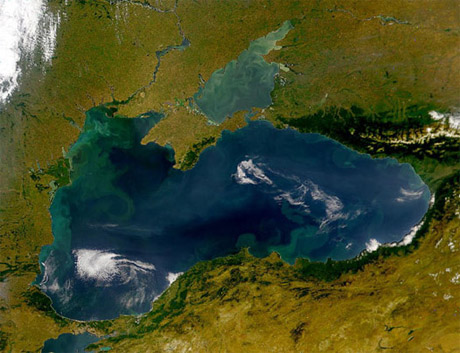
Black Sea from space - Black Sea from Space

Nevertheless, from the time when the historical and geographical documents we find the first mention of the Black Sea and up to now, accumulated a few dozen names of the basin. The great Greek colonization of this region in their written sources from the IX-VIII centuries. BC mentioned is the sea more than once. At first, the newcomers from the south sea met, apparently inhospitable. It was struck by their strong winter storms and ice near the northern coast. In addition, local residents - Brand - Deals damage to sensitive Greek sailors. This is probably why the Black Sea for a long time was called by the Greeks inhospitable sea.
 
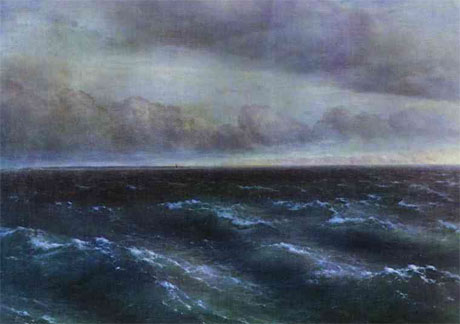
1881, Ivan Aivazovsky. The Black Sea
 
Over the years, with further penetration into the northern Black Sea region and settlement of its fertile shores, the Greeks began to call the sea hospitable (Evksinos Pontos). This name was recorded in the sea of ​​Herodotus (Vv. BC), as well as on the map of Ptolemy (AD IIv.) Descriptions of Pontus Euxine we find in the sailing directions of the time - Periplus (marine guide).
 
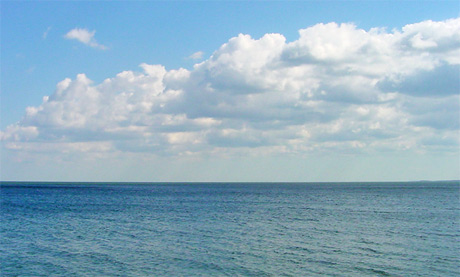
Black Sea coast of Crimea

Late Arab geographers, using scientific knowledge about the Black Sea, ancient scholars, greatly complement and enhance them with new information acquired as a result of strengthening trade ties with Middle Eastern Black Sea Region (Here lies the most famous trade routes: from the Vikings to the Greeks "and" The Great Silk Road . Judging from historical documents, the Black Sea was called then Russian. It was noted in the Arab scholars Masoudi (mid-XB). Edrizi and (XIIv.). This is not surprising, since the first documented use of the word "growing", "Rus" are connected namely the Crimea (Tavrica). Some Russes lived on the peninsula in IXv. and later. At the same time educator Cyril saw Tavrika book, "Russian written to write." But who was hiding under this name: the Scythians, or Slavs - to answer accurately can not nobody. The Greeks, for example, XB. Scythians were called Rus, and even brand-Scythians, Arabs are also specifically called Rus Slavs. It is obvious only that the Indo-Aryan reading the word "grown" means "bright white". It follows, as Paradoxically, the Black Sea at one time was called the "White" Sea - Russian? "and named it for several hundred years. At some Italian cards (portolanah) is the name persisted until the XV-XVIvv. But along with that name in some cultures and travel The Black Sea was called in its own way.
 

Since the famous traveler Marco Polo (XIIIv.) called the Black Sea in his great "book" Great Sea. Oriental authors at the same time often mentioned the Black Sea, under the name of Sudak (Surozh), thereby emphasizing the wide popularity of the Crimean mall Sudak (Sourozh). Outstanding is the domestic traveler Athanasius Nikitin, who was in the Crimea in XV century., Returning from his big trip, "the three seas to India, called the Black Sea (the third on its way) - Istanbul. There were other names: Cimmerian, Tauride, Crimean, Slavic, Greek, Georgian, and even Armenian. Why, for example, the Armenian? We can assume that when XIv. in the Crimea moved a large number of Armenians who ousted the Persians, and Seljuk Turks from their traditional territories and part of east Crimea current Belogorsk becomes Seaside Armenia - a significant economic and religious center, the sea, also known as Armenian.
 

In the ongoing struggle for dominance over the Black Sea next inscription on the map disappears along with the displacement of the next "owner" of the Black Sea.
 
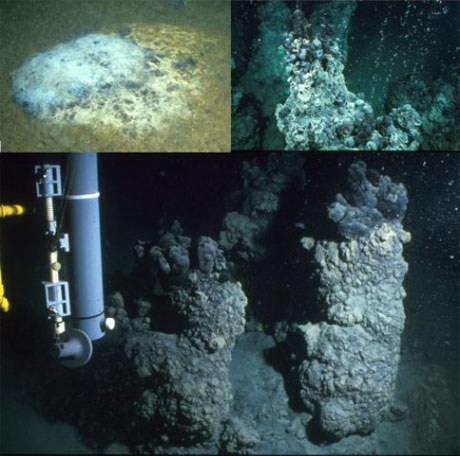
At the bottom of the Black Sea
Photo: GHOSTDABS - Hamburg University
 
Present the same name, returning, as we have said, for the Black Sea is held for several centuries. At the same semantic meaning in different languages ​​remains the same. Black Sea, for example, the Turks called Karadeniz on neo-Greek - Mauritius-Thalassa ", German" Shvartses Meer ", etc. Our sea called the black for a darker shade of its deep waters. This feature of the basin can be clearly seen in the transition from the Mediterranean to the Black Sea.
 
Deep-residents of the Black Sea

Why the sky is blue?

All colors and shapes that the sky has to offer, have a common property: they can not be imitated with the human. Whenever you try to reproduce them on canvas, paper, wood or metal will inevitably fail. They are the work of a teacher who has truly means "heavenly." His brush is sunlight, and his canvas is the volatile ether with its clouds and the soft tissue fine atmospheric dust: no artist available.

The sea air that surrounds us, is an inexhaustible source of joy to our eyes. The blue of a clear spring morning, the red-orange of a sunset on a plain, have made men enjoy, poetic language and investigate again and again. No matter where on Earth we live, we all share the same sky. Overhead, the sky appears to us as soon as pink ultramarine blue, now white or a delicate blue, decorated with clouds in the form of flakes, shreds torn or broken in powerfully swollen. The variability of this image is so large that never reproduced exactly. And the colors come in a palette so rich that our painters go, again and again, his eyes to heaven, for inspiration in the colors of a sunset or the rainbow.
 
The beauty of heaven is not merely the result of the interaction of sunlight with the atmosphere. A number of moisture, relatively small, accompanied by dust and ash is sufficient to cause the sky color the many manifestations of .
 
When there are extreme weather conditions may occur chromatic atmospheric phenomena such as the Rainbow Circles Ulloa, the Crowns solar and lunar halos False False Suns and Moons and more "rare" (Mirages, the Green Ray, Sacred Light, Aurora Polar Fires of San Telmo ...), optical phenomena that are totally explainable. Here we shall consider just the most common optical phenomenon that is the color of the sky in its various possible manifestations.
 
The secret of blue sky is related to the composition of sunlight-composed of the various colors of the rainbow-and humidity of the atmosphere. (The Sun is in charge of procuring air humidity. With heat, water causes some of Earth's surface evaporates. In invisible but incessant stream, moisture is directed into the sky from the oceans, seas, lakes and rivers, from the soil, plants and the bodies of animals and man).
 
To explain the blue sky, imagine that we let a ray of sunlight through a prism of glass. The light is opened in a range of colors (scattered) by refraction and as a result of this dispersion, we see a range of colors: purple, blue, green, yellow and red. The violet ray is the one that has spread over the white beam direction and that is precisely the explanation of the color of the sky. The maximum deviation of the rays of short wavelength (violet and blue), and lowest for long-wavelength (yellow and red), which are hardly deflected. Violet and blue rays, once diverted, collide with other particles of air and vary their path again, and so on: do, then a zigzag dance within the air before reaching the ground floor. When, at last, come to our eyes, do not seem to come directly from the Sun, but we come from all regions of the sky, as in a fine rain. Hence the sky appears blue to us, as the sun appears yellow, as yellow and red rays are slightly deflected and go almost directly in line from the Sun to our eyes.
 
If we delve a little more, the explanation is more complex. Light is an electromagnetic wave and the fundamental pieces of matter in its most common on Earth, are atoms. If the particles in the atmosphere, have a size equal to or less than the wavelength of incident light (single atoms or small molecules), the wave transfers its energy from nuclear crust begins to oscillate, so a first effect of the interaction of light with small particles of air is that the incident radiation is weakened by ceding part of its energy, what happens when sunlight passes through the atmosphere. Clearly this energy is not stored in the air, as any atom or small particle whose bark is shaken, just radiating all their energy in the form of electromagnetic wave to the environment in any direction. The entire process of assignment and transfer of energy by atomic sized particles known as Rayleigh scattering (named after the English physicist Lord Rayleigh was the first to give explanation) being the intensity of the scattered light is inversely proportional to the fourth power of the wavelength. The spread is greater, therefore, to shorter waves: As a result, we reach the same conclusion, violet light is more diffused and less red. The net result is that some of the light coming from the Sun in a straight line to reach the atmosphere diffuses in all directions and filled the whole sky.
 
The color of the sky should be violet because this is the shortest wavelength, but not, for two main reasons: because sunlight contains more violet and blue light because the human eye (which ultimately is the captures the images, although the brain interprets-), is more sensitive to blue light than violet.
 
The blue sky is due both to increased short-wave broadcasting. The color of the sun is yellow-red and not white, because if the white light from the sun, which is the sum of all colors, they should take the blue light gives a yellow-red.
 
The diffusion of gases is produced by very weak, however, when the thickness of gas is very large, as in the atmosphere, is obvious from the scattered light.
 
The fact that the spread is greater for shorter waves, is the basis for the use of fog lights.
 
Regardless of all the possibilities that may arise, it can be argued that the greater the number of particles that cloud the air, the worse will be the visibility through the air.
 
If the fog is "dry" due to the presence of smoke, dust or small water droplets, the yellow light - that part of the fog-just fade because of the filing of this fog, so it is visible through it. If the fog is "wet", the best lights against it fail almost completely, as the damp mist is formed by large droplets that spread almost equally, all colors of white light. The Sun itself, seen through the fog of large droplets, appears blurred and milky white, while observed when the fog is due to fine dust disk looks red, as often happens to be the star.
 
If light interacts with a large particle, not the mechanism of Rayleigh, occurs much simpler process: the particle simply absorbs some light and reflects the other side. Each particle behaves as a tiny mirror that reflects more or less light depending on their chemical composition and alter the color of the reflected light if the particle is composed of colored substances. If the light is with a distribution of large particles, some light is scattered and, moreover, may change color. This process is known as Mie diffusion, and the simplest example we have in the clouds, where water drops colorless, scatter light in all directions, but without altering their color. (The sky of Mars is another example of diffusion of Mie, caused by large-sized colored particles, so it is not blue, because the size of the particles does not allow the Rayleigh scattering).
 
If dissemination of Mie act en masse, if the diffusing particles are colored, the result is the attenuation of white light into increasingly darker gray. This is the reason why in the very cloudy days when the clouds are very thick, the sky appears more or less gray, and sometimes almost black.
 
The rising and setting sun give us a beautiful day shows, the most beautiful air can offer to our eyes.
If the horizon is large (as in the city of Badajoz), the effects are multiplied and the show is all a poem.
 
At sunset, the way that sunlight goes into the atmosphere is longer, the successive rebounds and other particles are likely to grow in the light ends colliding with a particle absorbing and disappear, so that even the yellow are affected and released and only the red rays, the most directional, follow a nearly straight line. Hence the red color of the sun.
 
The colors that offers us the sky in these cases also arise through the intervention of the molecules from the air and particles that it has suspended "the atmospheric aerosol, scattering sunlight and unfold in many ways .
 
Even before the sun sinks into the horizon, we see the color of the sky becomes more intense, more saturated. As the light that appears around the solar disc veers towards yellow-red and the horizon is yellowish-green, the blue becomes more intense at the zenith.
 
When the Sun is at an angular distance of the horizon of 1 or 2 degrees, pour the twilight sky on the edge of its magical light. Gradually, the yellow glow is transformed into a red-orange light, and finally, in a twinkling light tan, which sometimes tends to form the red color of blood. Day when the sun has disappeared below the horizon, is seen in the western sky a bright purple, which reaches its maximum when the sun has dropped about 5 degrees below the horizon. Above the place where the sun has been separated from the horizon by a narrow red-brown, is often a semicircle whose color varies from purple and pink. This coloration is due essentially to the refraction of sunlight on particles that cloud the air between 10 and 20 km. high, and disappears when the sun has come at 7 degrees below the horizon.
 
When there is an abnormally large quantity of aerosols (airborne dust), the light of sunrise and sunset is especially red. It usually happens when there are high atmospheric pressure (anticyclone) and the concentration of dust particles in the air is greater at high pressures. Very intense red color that we usually consider here in Extremadura, in the month of October and sometimes sporadic, may be due to increased aerosols from the burning of fallow crop.
 
If the earth had no atmosphere, sunlight would reach our eyes directly from the solar disk and would not receive scattered light and sky appear as black as night (the astronauts can see during the day the stars, moon and planets because they are outside the atmosphere).
In exceptional cases, special stains can occur due to the contribution of active volcanoes. At the time of the eruption of Krakatoa (26 and 27 August 1883, -36 000 killed by the eruption-) on the Earth witnessed a notable example. The eruption released to the air mass volume of the small rocky island of Krakatoa (located in the Sunda Strait, between Sumatra and Java) which is estimated at about 18 km. Chunks of rock the size of a human head were thrown upward with initial speeds of 600 to 1000 m / s, and the roar of the explosion was heard in Rodrigues (island of Madagascar) to 4774 miles away. The sky remained dark for several days. The finer particles of volcanic ash from the volcano spread to 80 km in height, were carried by air currents high and drove around the Earth twice. Were in the air phenomena fantastic color that continued even months after catastrophe, among others, there were amazing colors for the rising and setting sun and were soles of all colors, including red and green copper. Soles were also blue, as can also be seen on rare occasions in Europe when in Canada, for example, is a large forest fire and westerly winds dragged to our continent fine ash particles.
 
Because at dusk, the road that runs sunlight within the atmosphere is longer, as indicated above, is why the Sun looks more flat and wide as the effect of refraction through the atmosphere is very large.
Finally, the black of night, is because the atmosphere surrounding the viewer barely light and therefore can not provide enough circulation.